



We spend more time with our colleagues than we do with most of our families. Yet, the level of insight we have into their inner world often stops at their job title.
We’re all guilty of engaging in the universal language of corporate pleasantries. We nail the jargon, we meet the deadlines, and we master the art of the 3-minute conversation. In short, we’re building transactional relationships: I need $X$ from you, and I’ll give you $Y$ in return.
The problem is, this professional façade—this commitment to competence over authenticity—makes true leadership and influence nearly impossible. We’re constantly guessing. Why is Sarah so resistant to change? Why does Mark always push back on deadlines? When we rely on surface-level knowledge, we can only instruct, manage, or occasionally plead. We can’t inspire.
To lead effectively, you don’t just need to know what your colleagues do; you need to know how they think. You need the secret key to their Inner Operating System—the values, struggles, and self-image that dictate every decision they make.
But here’s the catch: you can’t exactly walk up and ask, “What are your deepest insecurities and professional values?” That’s a one-way ticket to an awkward HR meeting.
There is a brilliant shortcut. A low-stakes question that uses the universal language of pop culture to bypass the corporate filter and reveal their professional soul.
The next time you’re chatting, skip the weather report. Ask them this instead: “Which fictional character—from a movie, book, or show—do you feel is most like you, and why?”

Bypass the Small Talk Filter
So, why not just ask, “What are your core values?” Why resort to fictional avatars?
The answer lies in the human tendency to edit. If you ask a direct question about professional values, you’ll receive the highly curated, bullet-pointed list they prepared during their last performance review (e.g., “Integrity,” “Teamwork,” “Deliver Results”). This is their aspirational self. It’s useful, but it’s not the whole picture.
When you ask for a fictional match, you engage a different part of the brain—the narrative part. This is where the magic happens:
The Low-Threat Projection
Choosing a character is an act of low-threat projection. A colleague can admit, “I’m a lot like Hermione Granger,” and safely convey volumes about their meticulousness, their dedication to rules, and their fear of failure. They are talking about a fictional witch, but they are revealing themselves. It’s a workplace personality test.
Focus on the “Why?”
The character choice itself is merely the noun; the why is the verb. It is the real professional gold.
If they choose Captain Kirk, they are not necessarily saying they want to seduce aliens; they are saying they identify with bold, decisive risk-taking, even if it defies protocol.
If they choose David Brent, they might be joking about their awkwardness, but they are often also revealing a deep, perhaps clumsy, desire for connection and team acceptance.
The Shared Shorthand
Once you know their character, you have unlocked an emotional shorthand. You no longer have to explain complex situations from scratch. When a difficult decision looms, you can instantly reference their avatar in your mind and anticipate their reaction.

Pillar 1: Building Unbreakable Connections
The first, and perhaps most immediate, payoff of the Character Question is the ability to shift your relationship from being merely cooperative to genuinely connected.
In a fast-paced work environment, empathy is often treated like a luxurious add-on, something you only have time for after all the deadlines are met. But real empathy, the kind that builds deep connections, is simply the ability to understand why someone behaves the way they do, even if you disagree with the outcome.
The Human Element
A resume tells you where someone has been; the character choice tells you who they believe they are.
When you know their professional avatar, you stop treating them as a corporate function (e.g., “The Head of Marketing”) and start treating them as a human being with a specific set of motivations.
This insight allows you to connect on a human, emotional level that transcends professional boundaries. You now understand their professional journey and their internal narrative.
This subtle shift in perception allows you to interact with your colleagues as an ally. You are validating their self-identity, which is the quickest way to create a mutually respectful working bond.
Pillar 2: Cultivating Authentic Trust
We often confuse trust with reliability. We trust the accounting team will deliver the quarterly report on time. But genuine, collaborative trust goes deeper—it’s about reliably predicting how a person will behave when things get messy or stressful.
Trust is built on understanding intent, and your Character Question gives you a clear window into their professional ethics and moral code.
Trust is Prediction, Not Hope
When a colleague identifies with a character, they are revealing the ethical framework they admire or follow. You are no longer hoping they will make the right decision; you are predicting it based on their self-identified value system.
Safety Through Validation
Knowing their professional avatar allows you to offer proactive support, which is a powerful way to build trust.
For instance, if you know your colleague identifies with a character known for meticulous attention to detail and high anxiety (let’s call them “The Analyst”), you can predict they will struggle when you drop an urgent, ambiguous task on their desk.
By acknowledging their internal character and giving them what they need to succeed, (structure, support, or space), you show that you are invested in their success, not just the task. This creates a high-trust, safe working environment where colleagues are willing to take risks and speak up honestly.
Pillar 3: Mastering Professional Influence
We have established a connection (I see you) and built trust (I believe in you). The final step is translating that capital into influence.
Influence in the workplace is not about having the loudest voice or the highest title; it’s about making your goals align effortlessly with another person’s self-interest. If you know the story they tell themselves, you can frame your proposals in a way that makes them feel like the hero of the story.
Influence is Framing for Self-Identity
Stop trying to push your agenda. Start framing your proposals as the logical next chapter for their chosen character. This speaks directly to their inner motivation, bypassing resistance.
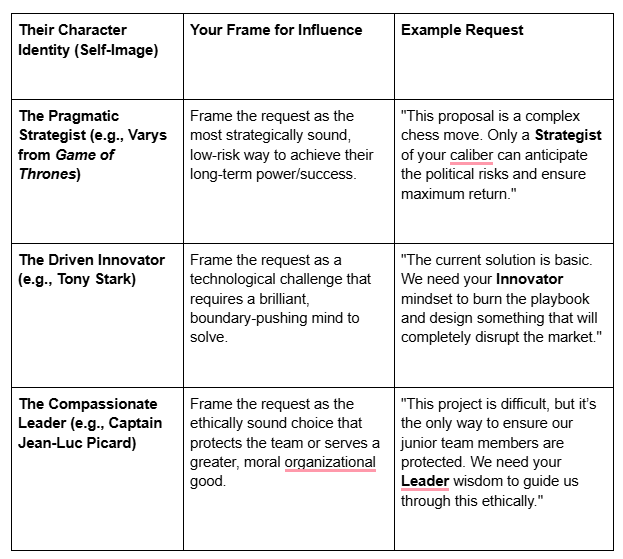
The Quiet Power of Alignment
When you successfully align your request with their self-narrative, the need for management disappears. They don’t see it as a task; they see it as their mission. This is where influence becomes fluid and effective. You aren’t forcing them to take on extra work; you are inviting their professional avatar to fulfil its purpose.
This deep level of understanding transforms routine delegation into a leadership masterclass. You know exactly which buttons to press because you understand what makes them feel competent, valuable, and professionally fulfilled.
The Power of Seeing Clearly
The modern workplace demands more than transactional relationships; it requires genuine human connection built on mutual trust. By stepping past the superficial façade and asking one simple question, you unlock the human dimension of your colleagues.